

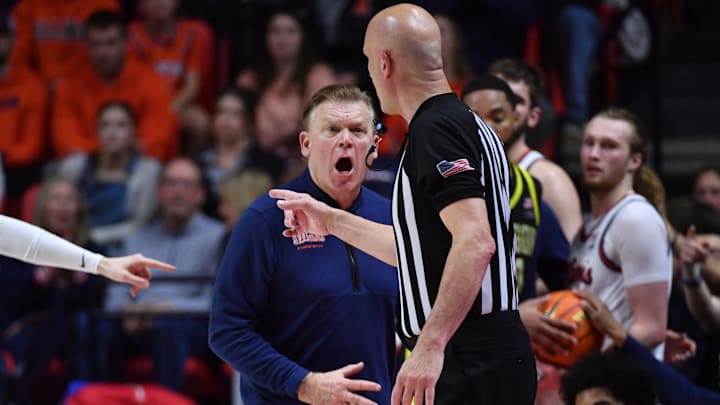
Before the 2025-26 season, the Illinois basketball team went through a radical roster transformation.
Sure, the Illini had Kasparas Jakucionis and Tomislav Ivisic as headline players on the 2024-25 roster. But those European stars were complemented by a variety of players who matched the previous staff’s roster construction.
Ty Rodgers and Morez Johnson Jr. were mentored by Tai Streets and Tim Anderson. They brought toughness, intensity, rebounding, defense, and unselfishness to a team full of scorers.
Dravyn Gibbs-Lawhorn was another Anderson recruit. He had explosive scoring ability and the aggression and mentality to be a defensive ace. The fact that he spurned hometown Purdue to sign with the Illini was a sign of the rugged individualism that defined his persona.
Bringing in Tre White from Louisville was a move to amplify playmaking and defense. White had length and rebounding ability,
Rodgers returned to the 2025-26 squad with an undefined role. Though an injury ate his entire season, the Michigan native had been heavily deprioritized after Anderson’s departure and wound up taking a 2024-25 redshirt.
Johnson, White, and Gibbs-Lawhorn all departed at the end of the season.
Illinois prioritized stretch bigs over Johnson, skilled forwards over White, and positional size over Gibbs-Lawhorn. They filled out the roster with perceived offensive stars over tough-minded two-way players.
The previously maligned Tyler Underwood has proven his skill in molding one of the nation’s top offenses for multiple consecutive seasons. While the fanbase’s derision of his coaching ability was misguided, the results are clear: Illinois is an offensive program.
It’s a skill over will argument. The staff chose clearly and forcefully.
Was it worth it?
That’s yet to be determined, but Illinois being in this place at this time with this group in this situation is deliberate. Underwood and the current staff eviscerated the mentality of the previous staff.
Did Johnson and Orlando Antigua see eye-to-eye on how the big man could develop? And why was he deprioritized so early and so heavily for the likes of Carey Booth and Ben Humrichous? Was it just his propensity to foul, or was there more to the story?
Did Gibbs-Lawhorn fit in Underwood’s mismatch-hunting offensive scheme?
Was White bound for a sudden departure anyway?
We may never know the answers to these questions.
What is clear is that the staff made its roster decisions largely based on skill level and offensive potential.
Gibbs-Lawhorn, Booth, White, and Johnson have all thrived in their new locations. Johnson, despite the harsh rejoinders of Illinois fans, has played his way into first-round draft pick territory.
Did Illinois basketball win the roster exchange?
Well, David Mirkovic was an unmitigated success this past season.
Keaton Wagler’s ascent may not have been as straight a line if Gibbs-Lawhorn and White had remained in Champaign.
Mihailo Petrovic replaced Gibbs-Lawhorn as the small guard expected to bring instant, furious offense. And his performance has been far below expectations. The ROI of his alleged salary vs. his productivity is possibly the worst in the history of Illinois in the NIL era.
Andrej Stojakovic has been a mixed bag. While the McDonald’s All-American five-star prospect in him has surfaced occasionally, the lack of consistency on both ends has been mind-boggling. Seeing Peja Stojakovic’s stoic face in the crowd in Chicago during the Illini’s Big Ten Tournament loss to Wisconsin spoke volumes.
This recruitment took full advantage of Antigua’s relationship-building prowess. Illinois passed on Jaylin Sellers and more significantly Dame Sarr in order to have the dry powder to lure Stojakovic, whom Antigua recruited at Kentucky. But on court, the program sits with more questions than answers.
Zvonimir Ivisic, another young man with deep ties to Antigua, has been inconsistent. The 7-foot-2, 3-and-D stretch No. 5 is a dream prospect for an Illinois system that prioritizes outside shooting and positional size. His inability to supplant his inconsistent twin, Tomislav, is quite telling. Both Ivisic brothers seem to be regressing, which begs the question: Is this Jimmys and Joes or X's and O's?
That question matters a great deal. One can be easily fixed, the other requires young men to change late in the game. These players have achieved great success in their young lives, and pivoting dramatically on the fly isn’t the easiest transition.
A 24-7 regular season in a top-heavy Big Ten is nothing to sneeze at. Earning a triple-bye in the Big Ten Tournament means you sit at the top of the conference. Brad Underwood has rebuilt Illinois basketball to a state of permanent competency.
But Illinois developed a penchant for blowing leads against less talented teams. It happened twice against Wisconsin within the state of Illinois. It happened at Pauley Pavilion and at the Breslin Center. These ugly losses underscored an inability to put their foot on an opponent’s throat.
In a kill-or-be-killed, win-or-go-home environment, Illinois has demonstrated the kinds of late-game ineptitude that result in early exits.
They had one in Chicago.
Can they prevent having another in Greenville?
 Add us as a preferred source on Google