

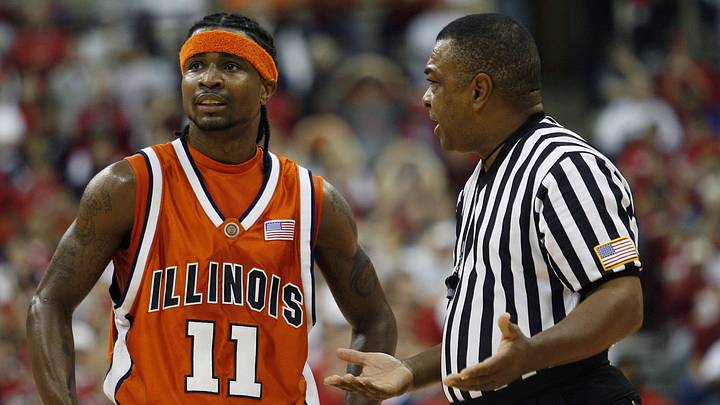
Lawyers are having their way with college sports, and this could have affected Illinois basketball greatly in years past.
Any player in the class of 2022 has been granted a fifth year of eligibility in college. That means someone like Kylan Boswell could technically return and play for Illinois once again.
This got me thinking, what other players in the history of Illinois basketball could have changed the program’s fortunes if they were granted a fifth year?
Well, like always, I have a list.
Here are the five Illinois basketball players who would have changed everything with a 5th year of eligibility
5. Trent Meacham – 2009-10
Illinois did have a randomly good season in the middle of the Bruce Weber era, going 24-10 overall and 11-7 in the Big Ten in 2008-09.
This team entered the NCAA tournament as a No. 5 seed and was upset in the first round by No. 12 Western Kentucky. That was an ugly loss, but what was even uglier was the fact that Illinois failed to make the postseason the following year.
Finishing 21-15 overall and 10-8 in the Big Ten in 2009-10, Illinois was missing some much-needed shooting. We had some good young players, but they were just freshmen.
If Trent Meacham had been able to return for a fifth year, he would have helped Illinois greatly in the shooting department. Instead, we had to rely on DJ Richardson and Brandon Paul for the deep ball.
That 2009-10 team was one of the most disappointing in recent memory. Meacham would have changed the course of that squad.
4. Marcus Griffin – 2001-02
The early 2000s were kind of like what Illinois is experiencing today. There was so much potential for a national championship. Marcus Griffin was a big part of that resurgence.
Griffin’s senior year was special, as Illinois went 27-8 overall and 13-3 in the Big Ten. We won the conference, and entered the NCAA tournament as a No. 1 seed. Illinois made it to the Elite 8 and fell short to No. 2 Arizona.
That team was so good, and Griffin was one of the leaders, averaging 11.3 points and 6.0 rebounds per game.
Illinois was laced with experience the following season, too. Frank Williams, Brian Cook, Cory Bradford, this team had the horses to go deep. We finished 26-9 overall and 11-5 in the Big Ten. As a No. 4 seed in the NCAA tournament, Illinois got to the Sweet 16 and lost by four points to No. 1 Kansas.
If Griffin had returned for a fifth year, everything could have changed. That four-point gap might have been a win. Another Elite 8 appearance might have turned into a bigger run. Who knows, a national championship might have been the outcome.
3. Dee Brown – 2006-07
The fact that Illinois got Dee Brown back for a fourth year was pretty lucky for fans, unlucky for Brown. A reported injury is what brought him back from the NBA Draft, but could you imagine him back on the roster for a fifth year?
Even with Deron Williams, Luther Head, and Roger Powell departing from the national title run the year before, Brown and James Augustine ran it back for Illinois in 2005-06.
This wasn’t a bad team. Brown was the lead dog on a team that went 26-7 overall and 11-5 in the Big Ten. He was one of the best players in the country, as Illinois was a No. 4 seed in the NCAA tournament but fell short in the second round.
After Brown’s departure, the Bruce Weber era officially kicked off. Illinois didn’t have direction, and the backcourt was not very good. Brown could have changed so much on that 2006-07 squad.
The year after Brown left, Illinois was 23-12 overall and 9-7 in the Big Ten. We were a bubble team and lost in the first round as a No. 12 seed. With Brown in the mix, Illinois is easily one of the better teams in the Big Ten, and this first round exit doesn’t happen.
2. Brian Cook – 2003-04
I believe Brian Cook was a product of bad timing. He was on some really good teams in the early 2000s, but it was his senior year that was unfortunate.
Cook was the senior leader on an Illinois team that went 25-7 overall and 11-5 in the Big Ten. We were a No. 4 seed in the NCAA tournament but fell in the second round.
Inexperience killed the Illini. Cook was surrounded by freshmen, including Dee Brown, Deron Williams, and James Augustine. Even the more experienced players, Roger Powell and Luther Head, were only sophomores.
Cook departed, and the following season, Illinois was better because of the youth improving. Illinois went 26-7 overall and 13-3 in the Big Ten. This team got to the Sweet 16, too.
Just imagine if Cook came back for a fifth year and was on that 2003-04 Sweet 16 squad. That team could have easily been a No. 1 seed that season with Cook in the middle of the paint. Who knows, maybe with a more experienced big man like Cook, Illinois makes it and wins a national championship?
On top of that, Augustine could get more knowledge and learn from Cook for one more season. This might have made him even better for the national championship run the following year when Illinois fell just short.
Cook coming back for a fifth season would have been incredible. Illinois would have been insanely good.
1. Kenny Battle – 1989-90
The Lou Henson era of Illinois basketball had some great programs, and the 1988-89 squad is arguably the greatest in the long history of the team.
Illinois went 31-5 overall and 14-4 in the Big Ten during that 1988-89 campaign. We went to the Final Four and fell short to Michigan.
Most of that great run returned the following season. One player who didn’t come back but could have changed everything with a fifth year of eligibility is Kenny Battle.
Battle was Illinois’ second-leading scorer on the Final Four team. He averaged 16.6 points, 4.8 rebounds, and 1.8 assists per game in 1988-89. Those numbers were dearly missed the following season.
Illinois actually had a pretty good team the following season. The Illini finished 21-8 overall and 11-7 in the Big Ten in 1989-90. We entered the NCAA tournament as a No. 5 seed and fell to No. 12 Dayton in the first round.
Moreover, that team had talent. Kendall Gill, Marcus Liberty, and Stephen Bardo all returned as key cogs. Adding Battle’s massive numbers in a fifth year would have given Illinois the ability to secure a top-three seed in the NCAA tournament. Who knows where this program would have gone if Battle were back in the fold?
 Add us as a preferred source on Google